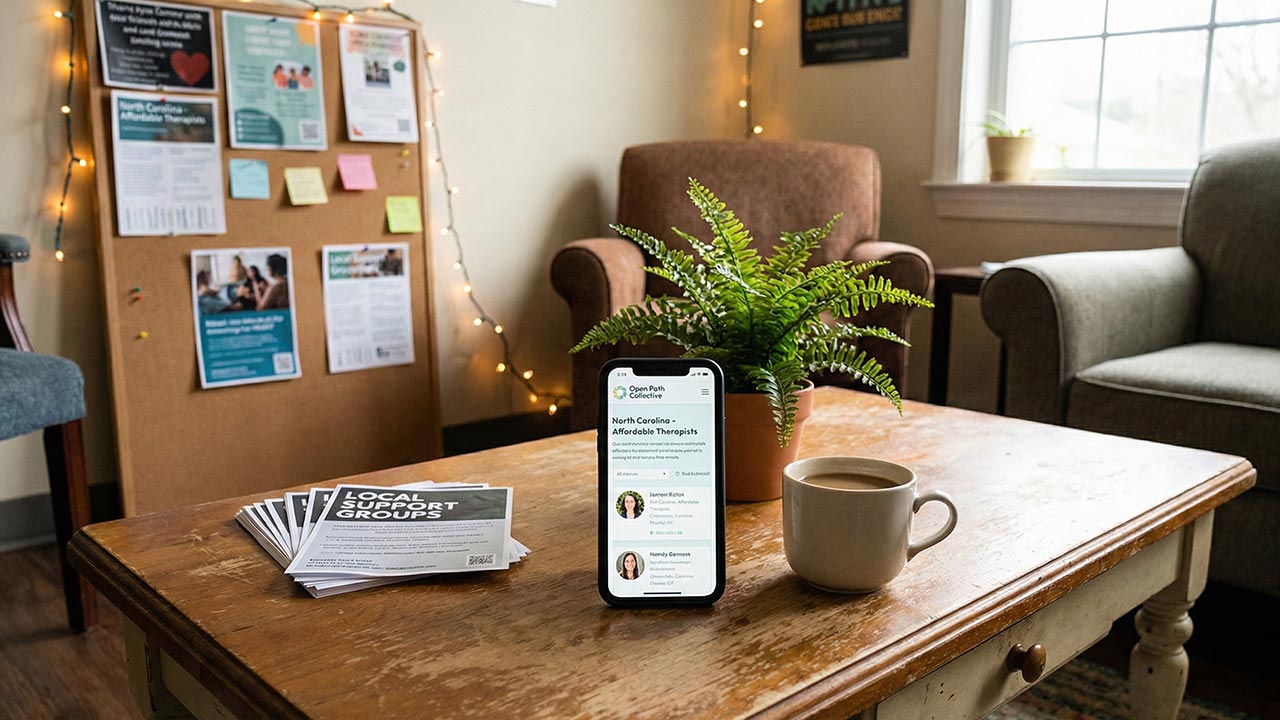
Low-Fee & Medicaid Options: Because Liberation Shouldn’t Be a Luxury
There is a painful irony in the wellness world: The people most harmed by systemic weight stigma—often those in marginalized bodies with fewer economic resources—are the ones most often priced out of the therapy designed to heal it.
If you have searched for “Fat Liberation Therapy” or “Eating Disorder Specialists” in North Carolina, you’ve likely hit a wall of private pay practices charging $175 to $250 per session.
It is valid to feel angry about this.
Liberation should not be a luxury good. Healing from diet culture and body hatred is a right, not a privilege reserved for those with disposable income.
Fortunately, North Carolina has a robust, albeit sometimes hidden, safety net of weight-inclusive care. From university training clinics offering $5 sessions to new Medicaid plans specifically designed for complex behavioral health, affordable options do exist.
This guide is your map to the underground railroad of accessible care in NC. We are breaking down how to find high-quality therapy for $50 or less, how to navigate the new Medicaid “Tailored Plans,” and where to apply for grants that pay for your treatment.
1. The “Intern” Model: High-Quality Care for $10–$50
One of the best-kept secrets in mental health is the Clinical Intern.
Interns are graduate students in their final year of a Master’s or Doctoral program. They have completed their coursework and are now practicing under the close supervision of highly experienced, licensed therapists.
Why choose an intern for Fat Liberation?
- Fresh Perspective: Interns are often learning the newest modalities. They are more likely to be trained in social justice, anti-oppression, and HAES® frameworks than a therapist who graduated 30 years ago and hasn’t updated their views on weight.
- Double the Brainpower: Because they are supervised, your case is being reviewed by two therapists (the intern and their supervisor). You get expert oversight at a fraction of the cost.
- The Price: Sessions typically range from $10 to $50.
Spotlight: Winter to Spring Wellness (Asheville/Virtual)
This practice is a leader in making liberation accessible. They have explicitly built a tiered model to serve the community.
- The Offer: They host clinical interns who provide therapy for $10–$50 per session.
- The Vibe: Their interns are trained in “anti-racist, fat liberation, disability justice, and liberation psychology frameworks.” This is not just general counseling; this is politically aware care.
- Access: Available virtually statewide and for “Walk & Talk” sessions in Asheville.
Spotlight: University Training Clinics
North Carolina’s universities operate training clinics for their PhD psychology programs. These clinics are open to the community (not just students) and use sliding scales based on income.
- UNCG Psychology Clinic (Greensboro): Offers sliding scale fees (often starting very low) for individual therapy and assessments. They are a non-profit training clinic committed to serving the underserved.
- ECU PASS Clinic (Greenville): The “Psychological Assessment and Specialty Services” clinic offers therapy on a sliding scale (historically $5–$30) and does not bill insurance, removing the need for a diagnosis if you prefer to avoid one.
- Appalachian State Psychology Clinic (Boone): Serves High Country residents with a sliding fee scale based on household income.
- Western Carolina University (McKee Clinic – Cullowhee): Provides affordable psychological evaluations and therapy to the WNC community.
2. Medicaid in NC: The “Tailored Plan” Revolution
If you have Medicaid in North Carolina (especially following the recent expansion), the landscape for Eating Disorder (ED) treatment has shifted significantly with the launch of Tailored Plans.
Standard Plans vs. Tailored Plans
- Standard Plans: For most Medicaid beneficiaries with mild to moderate health needs. Covers basic therapy and medical care.
- Tailored Plans: Designed for individuals with significant behavioral health needs, including severe eating disorders, serious mental illness (SMI), and substance use disorders.
- Managed by LME/MCOs: Organizations like Vaya Health, Trillium Health Resources, Alliance Health, and Partners Health Management.
- Why it matters: Tailored Plans often cover enhanced services that Standard Plans do not, such as Residential Treatment or Intensive Outpatient Programs (IOP) for eating disorders.
How to Access This Coverage
If you are struggling with a severe eating disorder and have Medicaid, you may qualify for a Tailored Plan.
- Contact your LME/MCO: Look at your Medicaid card to see which entity covers your county (e.g., Vaya in the West, Trillium in the East/Coast, Alliance in the Triangle).
- Request an Assessment: Ask for a screening for “Tailored Plan eligibility based on a severe eating disorder diagnosis.”
- Provider Spotlight: Radical Healing in Durham accepts several Medicaid plans (Healthy Blue, United Community Plan, Wellcare) for both therapy and primary care. They are one of the few explicitly HAES-aligned, queer-and-BIPOC-centered clinics in the state accepting Medicaid.
3. The Grant Strategy: Let Others Pay Your Bill
If you cannot afford a sliding scale and do not have Medicaid, your next step is Third-Party Funding. There are national and local organizations that exist specifically to pay for therapy for marginalized communities.
The Loveland Foundation
- Who it’s for: Black women and girls (cis, trans, and non-binary).
- What they provide: Vouchers for 4–12 sessions of therapy.
- How to use it: You apply during their enrollment windows. Once approved, you can choose any therapist who accepts the voucher. Many NC therapists (like those at Three Oaks Behavioral Health or independent providers) accept Loveland vouchers.
Project HEAL
- Who it’s for: People with eating disorders who are uninsured or facing insurance denials.
- What they provide:
- Cash Assistance: One-time grants to pay for treatment.
- Treatment Placement: They partner with centers (like The Emily Program or Monte Nido) to offer free spots to Project HEAL beneficiaries.
- Insurance Navigation: Free expert help to fight your insurance company for coverage.
Radical Healing’s “Black Mental Health Fund”
- Location: Durham/Virtual.
- Mission: This internal fund provides free mental health care to Black queer and trans individuals. It is a direct mutual aid offering, bypassing the insurance system entirely.
4. The “Pro Bono” Network
For those in the Triangle (Raleigh-Durham-Chapel Hill) and surrounding counties, there is a formal network dedicated to free care.
Pro Bono Counseling Network (PBCN)
- Service Area: Orange, Durham, Person, and Chatham counties.
- Eligibility: For residents who are uninsured or underinsured and cannot afford therapy.
- The Model: They match you with licensed therapists in private practice who have agreed to take on a set number of clients pro bono (for free).
- Advantage: You get to see an experienced private practice therapist who might normally charge $150+, for free.
5. Safety Net Resources for Medical & Nutrition Care
Therapy is only one piece of the puzzle. If you need medical care or medication without shame (and without a high price tag), consider these options.
NC MedAssist
- What it is: A free pharmacy program for uninsured NC residents.
- The Benefit: If you need antidepressants, anti-anxiety medication, or meds for chronic conditions (diabetes, hypertension) but can’t afford them, NC MedAssist can mail them to your home for free.
- Weight Neutrality: This removes the barrier of having to see a doctor just to get a refill, allowing you to stay on your medication regimen.
Federally Qualified Health Centers (FQHCs)
These are community health centers required by law to provide care regardless of ability to pay, using a sliding fee scale.
- Western NC: AppHealthCare and Blue Ridge Health.
- Triangle: Lincoln Community Health Center (Durham) and Advance Community Health (Raleigh).
- Coast: MedNorth (Wilmington).
- Tip: While not every doctor at an FQHC is HAES-trained, these centers are often more culturally competent regarding the social determinants of health (poverty, food access) than high-end private practices.
Food & Nutrition
- Nutrition Services: The Compass Center in Chapel Hill sometimes offers nutrition education or referrals.
- Mutual Aid Groups: Look for groups like “Food Not Bombs” (active in Raleigh and Asheville) or local mutual aid hubs (e.g., Asheville Survival Program) which often provide food without means testing or judgment.
6. Action Plan: Where to Start If You Have $0
If you are in crisis or need care immediately and have no funds, follow this step-by-step triage plan.
Step 1: The “Open Path” Check.
- Go to Open Path Collective (openpathcollective.org).
- Search for therapists in North Carolina.
- Cost: You pay a one-time lifetime membership fee (~$65), and then sessions are guaranteed to be between $40–$70. This is the fastest way to find a private therapist at a lower rate.
Step 2: The University Pivot.
- If $40 is too high, call the psychology clinic at the NC university nearest you (UNCG, ECU, App State, UNC-CH). Ask: “Do you have a sliding scale for community members, and do you have a waitlist?”
Step 3: The Medicaid Application.
- If you have no insurance, apply for NC Medicaid immediately via ePASS.nc.gov. The income limits have increased, and you may now be eligible even if you weren’t before.
- Once approved, look for providers like Radical Healing or reach out to your LME/MCO (Vaya, Trillium, Alliance) to find an in-network provider.
Step 4: Support Groups (Free).
- While waiting for a therapist, join a free support group.
- The Alliance for Eating Disorders offers free, therapist-led virtual support groups.
- Eating Disorders Anonymous (EDA): Free, 12-step style (but weight-neutral) meetings available online and in some NC cities.
Conclusion: You Are Worthy of Care
The system makes it hard to find affordable, non-stigmatizing care, but it is not impossible. There are providers in North Carolina—from the interns at Winter to Spring to the advocates at Radical Healing—who are actively working to dismantle these financial barriers.
You do not have to wait until you are “rich enough” to heal. You do not have to wait until you are “sick enough” to deserve help. Use these resources to build the safety net you deserve today.
Disclaimer: This guide is for educational purposes. We are not a crisis service. If you are experiencing a mental health emergency, please call 988 or go to your nearest emergency room.