
41 Clayton St Suite #300, Asheville, NC 28801
102 Commonwealth Ct, Suite B, Cary, NC 27511



41 Clayton St Suite #300, Asheville, NC 28801
102 Commonwealth Ct, Suite B, Cary, NC 27511
“When you can talk about your feelings with someone you trust, they become less scary and overwhelming ”

With online therapy, geographical constraints are a thing of the past. Picture the flexibility of conducting your therapy session from a stationary car, the tranquility of your home, or the privacy of your office space.
At Resilient Mind Counseling, our goal is to dismantle the obstacles preventing individuals from obtaining premier mental health counseling throughout North Carolina. By simplifying the process of accessing care, we enhance the likelihood that individuals will receive the essential support they require. This is particularly true when it comes to connecting with an online therapist who is perfectly suited to meet your distinct needs.
Online therapy in Raleigh North Carolina allows access from anywhere. Imagine being able to do your therapy session from your car, your home, your office, etc.
Research shows that online therapy is equally if not more effective. Furthermore, it supports growth, change, and healing.
There are quite a few benefits to online therapy in Raleigh North Carolina.

Teletherapy is easy. First, you will receive a link to meet with your online therapist, just like the Zoom calls that we’ve gotten so used to over the last couple of years.
Then, click the link and you’re in the virtual therapy office. As long as you have a good wi-fi or cellular connection, you’re good to go!
Get appointment reminders, ease of access to care, and quality therapy. Getting started today is as easy as calling or texting 828-515-1246.
Resilient Mind Counseling specializes in online therapy throughout Raleigh and North Carolina for teens 12+ and adults. We specialize in anxiety, trauma, LGBTQIA+ issues, ADHD, BIPOC struggles, depression, and more.
Healing takes time and asking for help is a courageous first step. It starts with a click of a button or a phone call. Start your virtual therapy journey today and get connected to someone who can help you with your mental health goals.
**Please do not drive your car while participating in online therapy**
Our online therapists in Raleigh North Carolina are here to support you from wherever you are in the state. At our Asheville mental health practice, we strive to ensure people have access to quality therapy services in Asheville, NC, or anywhere else in the state. Reaching out to an online therapist can be hard but it takes three steps to get the support you need.
STEP-01
Start by reaching out to us
for a free consultation.
BOOK NOW

STEP-02
Then you can schedule your first appointment with one of our online therapists.
Choose Therapist
STEP-03
Get the support and understanding
you need and deserve!
Start Now
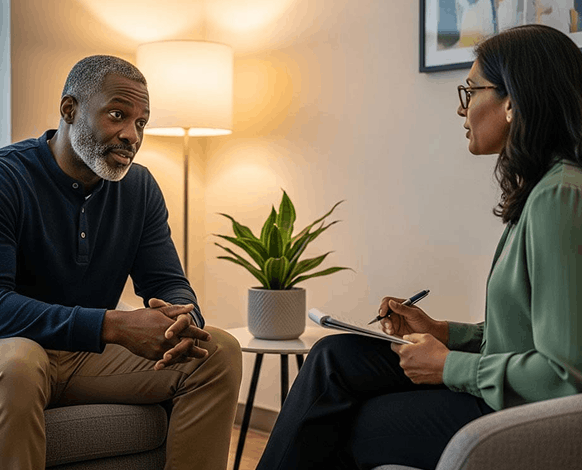
Our counselors based out of our North Carolina mental health office offer lots of mental health services through Virtual therapy. These include anxiety treatment, depression treatment, bipolar disorder treatment, trauma therapy, and PTSD treatment. In order to help strengthen your relationship, we have marriage counseling and couples therapy. If you are struggling with LGBTQ issues, BIPOC struggles, or neurodivergent obstacles we have online therapists who specialize in that as well.
We accept payment through a HIPAA compliant payment processing software.
This ensures that your financial information remains encrypted and protected.
Therapy can be vulnerable and new, so it’s natural to be nervous. It can be scary to think of opening up or crying in front of someone new, perhaps fearing that it will be awkward and uncomfortable. The fear around that can feel overwhelming. Getting the counseling we need can be challenging. And although it’s normal to be nervous, that doesn’t make it feel great. It takes courage to continue getting the help you need.
Therapy is a space where you can be yourself and feel safe from judgment, including feeling nervous. We’re committed to finding a way to care for your nervousness and ensure sessions are as comfortable as possible.
We’re here if you want to talk about it during a free phone consultation.
Take your time to read through this website. If you sense that we may be a good fit based on what you are reading, you can call us.
During a free phone consultation, you can ask one of our therapists about how they have helped other people like you before, ask how they work as a therapist, or any other questions you may have that are specific-to-you. You’ll also be able to tell them what’s up, and you and one of our therapists can decide together how they can help.
It will usually take a couple of sessions to feel comfortable and develop a relationship. During the sessions, you’ll be able to understand how comfortable you feel in sessions. Our approach is not going to work for everyone. What’s most important is that you find someone who you feel is the right fit for you. We can explore that together.
If something feels overwhelming or even terrifying to discuss, that’s actually very normal. It can often feel difficult to talk about some things. During sessions, your therapist will never push you to talk about things that are too painful for you to talk about. They will be there to guide you towards discovering what feels comfortable for you to share. Working at your pace, together you can look at the tough stuff if you’re ready.
You can also share with them that you are nervous to open up about something, and you and your therapist can talk about that too. Whatever is present for you. Whatever you are going through. Bring that to session and you can explore that together.
If you open up, we will not think you are crazy. We will think you are someone who’s very courageous. Many clients have had the same fear (that people would think they are crazy).
Through our own life journeys and working with clients, we know how “normal” your experience is.
You’re not being dramatic or “too much.” Nothing you can say will cause us to judge you.
We know nobody’s perfect. We all struggle. We all suffer in different ways.
Whatever it is you’re going through, we provide a safe space where you can feel heard and supported without judgment.
You might already know that you want to share sensitive information about your loved ones and you don’t want them to find out what you’ve said. So we want you to know that unless there is an imminent danger to yourself or someone else, everything you share is completely confidential.
There is nothing more important than your privacy.
You can rest assured that you can talk about anything without fear of that information getting out.
If you have specific questions about how confidentiality works, you can ask during your free phone consultation or anytime during your work with your therapist.
Overall, you can think of the first session as a structured assessment that helps your therapist get to know you and the challenges that brought you into treatment. They’ll invite you to share more about yourself, and you can also talk about what’s worked or not worked for your mental health in the past.
Some questions that your therapist might ask during a first session include:
You can ask your therapist questions as well. You might be curious about their experience or how future sessions work.
The most important part of a first session is that you see if you feel your therapist is a good fit for you. If you feel supported, seen, and at ease with them, you can discuss if you’d like to meet again.
Sometimes the hardest part is getting started. We’re here to make it easier with a free consultation—just a conversation, no pressure, only support.