



Why We Misunderstand Each Other: The Double Empathy Problem in Neuro-Mixed Relationships

It’s the same fight, over and over again. Partner A (Neurotypical): “You hurt my feelings when you walked away while I was crying.” Partner B (Autistic): “I didn’t walk away because I don’t care. I walked away because you said you wanted space earlier, and I was respecting that rule.” Partner A feels abandoned. Partner […]
Parallel Play: The Autistic Love Language of “Being Alone Together”

We are raised on a diet of romantic movies that tell us what intimacy looks like: Intense eye contact. deep, hours-long conversations over dinner. Cuddling on the couch while watching a movie, limbs intertwined. So, when you find yourself sitting on the couch scrolling through TikTok while your partner plays Zelda on the other end […]
Why Are So Many Autistic People Gender Diverse? Understanding the “Neuroqueer” Intersection

If you spend time in either the neurodivergent community or the LGBTQIA+ community in North Carolina, you will notice a striking overlap. It often feels like almost everyone who is Autistic is also Queer, Trans, or Non-Binary, and vice versa. This isn’t just an anecdote. Research consistently shows a significant statistical overlap between neurodivergence (specifically […]
Queer in the Bible Belt: Navigating Religious Trauma and Finding Safety in North Carolina

“Hate the sin, love the sinner.” “Pray the gay away.” “It’s just a phase.” If you grew up LGBTQ+ in North Carolina, these phrases are likely burned into your memory. In the South, religion is not just a Sunday activity; it is the water we swim in. It dictates our laws, our school boards, and […]
Neuroqueer Therapy: Honoring Your Brain and Your Gender

If you exist at the intersection of being Neurodivergent (Autistic, ADHD, AuDHD, Plural) and LGBTQIA+ (Trans, Non-Binary, Queer, Ace), you might feel like you are constantly translating yourself. In traditional medical settings, you are split into pieces. The gender clinic asks you to prove you are “stable” enough for hormones, ignoring that your meltdowns are […]
The Chore War: Navigating Executive Dysfunction in Relationships (Without Becoming a Parent to Your Partner)

It starts with a sock on the floor. Then a pile of mail on the counter. Then a forgotten utility bill. Eventually, it explodes into the argument that ends marriages: “I am not your mother! Why do I have to remind you to do everything?” “I was going to do it! Stop nagging me!” This […]
Sensory Trauma: When the World is Too Loud

When we think of “trauma,” we typically think of “Big T” events: war, assault, natural disasters. We think of singular, catastrophic moments that divide life into “before” and “after.” But for Autistic and sensory-sensitive people, trauma often looks different. It is not a single explosion; it is a slow drip. It is the cumulative, corrosive […]
Religious Trauma and Neurodivergence: Why We Are Susceptible

In the “Bible Belt” of the South, religion is more than just a Sunday activity; it is a cultural framework that dictates social rules, moral hierarchies, and community belonging. For many, it provides comfort. But for neurodivergent people—those with Autism, ADHD, or AuDHD—high-control religious environments can become a specific source of deep, lasting psychological injury. […]
Autistic Burnout vs. Depression: Why Standard Therapy Isn’t Working

You have tried everything. You’ve taken the SSRIs. You’ve sat on the beige couch and filled out the CBT worksheets. You’ve forced yourself to go for walks, meet friends for coffee, and “get out of the house,” just like your therapist suggested. And yet, you feel worse. The exhaustion is not lifting; it is settling […]
Affirming Care vs. Compliance Training: Why We Don’t Use “Rewards and Consequences”
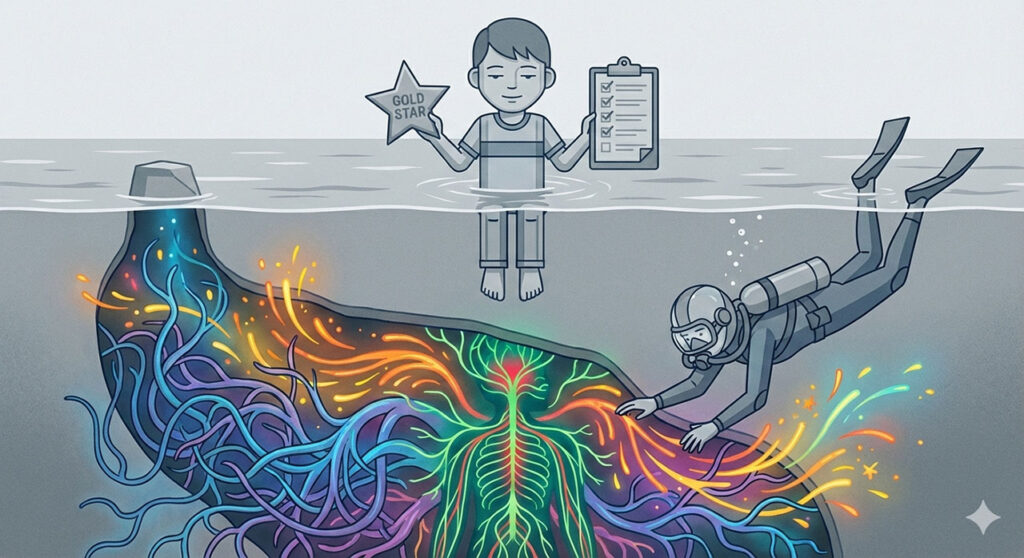
For decades, the standard advice given to parents of neurodivergent children—particularly those with Autism and ADHD—has been rooted in a single, unwavering philosophy: Behaviorism. You’ve likely heard the scripts: “If he screams, ignore him.” “If she sits quietly, give her a sticker.” “You must be consistent with consequences.” “Don’t let them get away with it.” […]